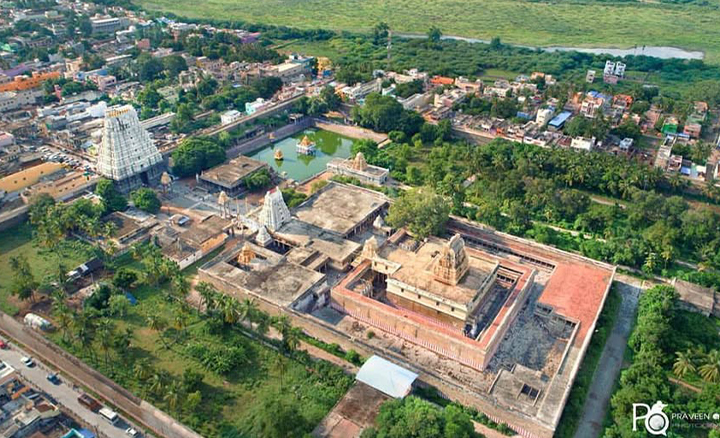



Baolis or stepwells, are subterranean water reservoir structures unique to the Indian subcontinent, which were developed in response to manage the arid climatic conditions and long dry summers in the region. One such example is the Baoli of Kanech in Ludhiana, the modern State of Punjab. Kanech Ki Baoli was conceived as a functional water structure rather than a monumental one, forming part of a wider network that supported travel and movement in the region.
Kanech Ki Baoli is believed to have been built in the late 16th century, placing it at roughly 425–500 years old. Modest in scale when compared to the deeply carved and monumental stepwells of Gujarat and Rajasthan, its architectural simplicity reflects its role as a practical roadside water structure rather than a ceremonial one.
Following a decisive victory of Sher Shah Suri over Humayun at the Battle of Kannauj in 1540, led to the establishment of the newly formed Sur empire. One of Sher Shah Suri’s most enduring contributions was the transformation of the Agra Lahore route, also known as the “Grand Trunk Road”, a well-planned imperial highway that supported trade, administration, and military movement. Several constructions were commissioned along the imperial highway. Among them, Kanech ki Baoli also functioned as a halt point providing water and shelter to travelers along the major historic routes. The Baoli did not fall out of use with the decline of the empire, instead it underwent repairs in 1891 under the patronage of the Sikh rulers, followed by further restoration during the colonial period. The historical patterns suggest that Sikh rulers often adopted, repaired and maintained earlier water structures to ensure their continued use by the community. These later interventions, largely involving brick reinforcement, ensured structural stability and the Baoli’s continued use. The Kanech Baoli thus remains a tangible fragment of the historic road system, offering insight into how Baoli’s operated as essential components of imperial highways rather than isolated architectural structures.
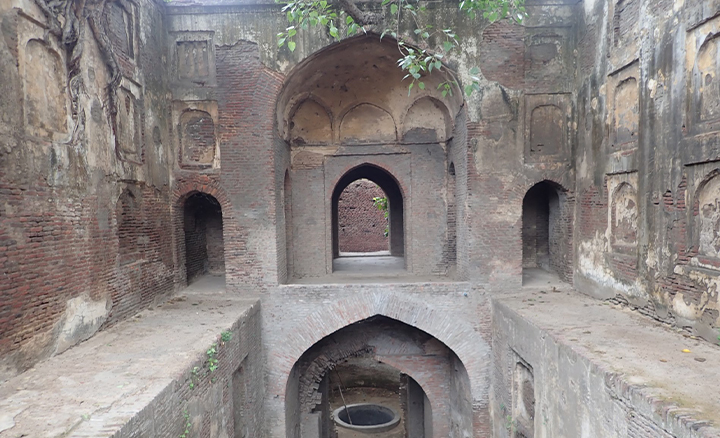
Noticeable features: vaults, arches and well shaft
(Image Source: National Mission on Monuments and Antiquities. (n.d.). Built heritage detail. Retrieved November 27, 2025, from https://nmma.nic.in/nmma/builtDetail.do?refId=)
Architecture
The Baoli of Kanech reflects an Indo-Persian architectural style prevalent during the period, characterized by a geometric layout and the use of locally available materials, both efficient to construct and climatically responsive. It is a double-storey Baoli built using lakhori bricks (thin, flat, fire-baked red clay bricks) which were widely used in Indo-Persian architecture. The structure demonstrates skilled masonry appropriate for interior structural parts and arches. Lime mortar (a composition of lime, brick dust and natural additives) was used as a binding substance in the masonry offering structural durability and strength; and also, resistance from prolonged contact with water.
This Baoli is supported by a system of arches and vaults that resulted in subterranean chambers bearing the pressure of the ground above. The lower-levels, accessible by the steps had spaces for rooms, called ‘Tahkhana’ (basement). The numerous arched niches and rooms at underground levels functioned as resting places, offering respite during the summer months, known as “Sarad-Khanas” (cool rooms).
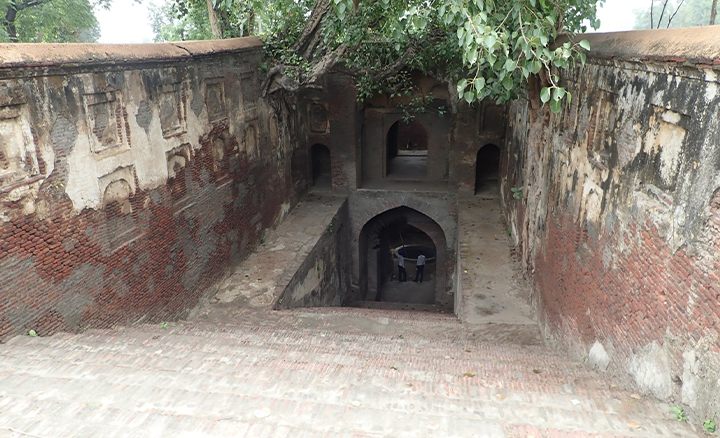
Entrance to the Baoli
(Image Source: National Mission on Monuments and Antiquities. (n.d.). Built heritage detail. Retrieved November 27, 2025, from https://nmma.nic.in/nmma/builtDetail.do?refId=)
Features of Kanech Baoli
The entrance to the Kanech Baoli leads into a long flight of steps that descends into the structure. Although the structure remains open to the sky and is illuminated by natural daylight, the walls contain carved niches that were likely used to place oil lamps, especially in the lower chambers during the evening hours.
The well at the lowest level forms the central and most functional element of the Baoli. Unlike many Baolis, Kanech ki Baoli is capped with a dome, a feature that is relatively uncommon in such structures. The well is circular in plan, with a stone-lined shaft reinforced by an additional brick casing that provides structural stability and prevents collapse.
Although the well is dry today, the relatively shallow depth of the Baoli suggests that the groundwater level was higher at the time of its construction due to its location in the riverine plains of Punjab.

Exposed lakhori bricks
(Image Source : National Mission on Monuments and Antiquities. (n.d.). Built heritage detail. Retrieved November 27, 2025, from https://nmma.nic.in/nmma/builtDetail.do?refId= )
Current state
The Kanech ki Baoli is an unprotected heritage site. The structure today has weathered and is in a deteriorated condition, standing as a testament to the time that saw the construction of the Imperial Grand Trunk Road.
Surviving as an example of Punjab’s traditional water reservoirs and a reminder of locally engineered water systems that once sustained travel and settlements across the region, the Baoli today requires urgent attention and protection.
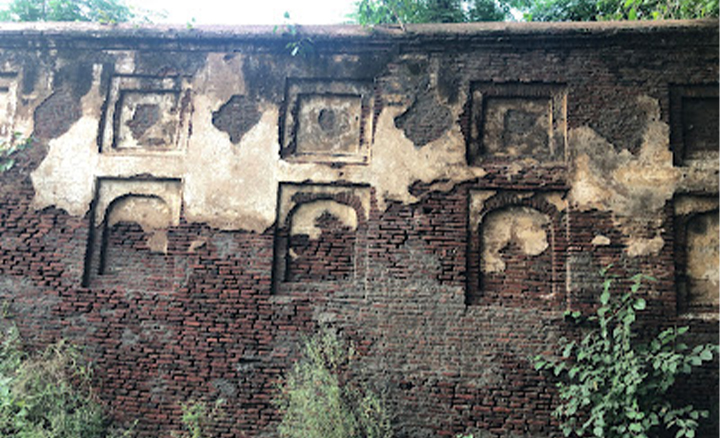
Visible signs of deterioration: vegetative growth, dampness and eroded plaster
(Image Source: National Mission on Monuments and Antiquities. (n.d.). Built heritage detail. Retrieved November 27, 2025, from https://nmma.nic.in/nmma/builtDetail.do?refId=)
Citation:
- Parihar, S. (2008), Land transport in Mughal India: Agra Lahore Mughal highway and its architectural remain, (pp. 227–228) Aryan Books International.
- National Mission on Monuments and Antiquities. (n.d.). Built heritage detail. Retrieved November 27, 2025, from https://nmma.nic.in/nmma/builtDetail.do?refId=
- Kanech Bawdi | Shershah Suri ki Bawdi | Ludhiana| Punjab Heritage. (2021, November 14). Kanech Bawdi | Shershah Suri ki Bawdi | Ludhiana| Punjab Heritage [Video]. YouTube. https://youtu.be/Au7OXzRl7_Q
- Rodgers, C. J. (1891). Revised list of objects of archaeological interest in the Punjab. Archaeological Survey of India. https://archive.org/details/dli.csl.7708
- National Mission on Monuments and Antiquities. (n.d.). Built heritage listing: Baoli at Kanech (ID: PB09013315). Archaeological Survey of India. https://nmma.nic.in/nmma/builtDetail.do?refId=13315&state=