

Pune today is a picture of buzzing streets, colleges, an IT hub, and a city that’s constantly on the move. But long before it became a centre for education and innovation, Pune’s story began by the banks of two rivers – Mula and Mutha. These rivers were the city’s first lifelines. To understand Pune, we must start with the water that made it possible.

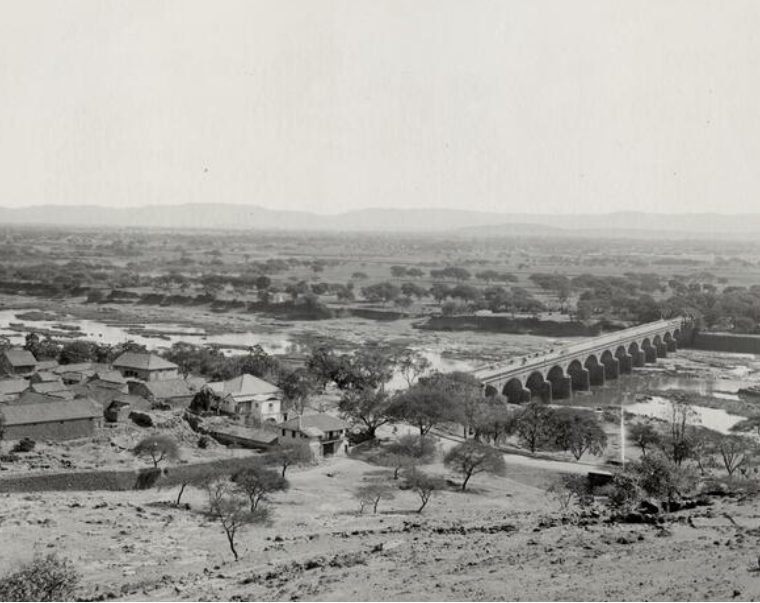
The Mutha River begins its journey in the majestic Western Ghats, gracefully flowing eastward. The Mula River, on the other hand, starts its descent in the Mulshi Hills. Both rivers wind through various terrains before reaching a key intersection, or “Sangam”, in the centre of what is now Pune. Today, that confluence is marked by the Sangam Bridge, where the Mula and Mutha rivers meet to form the Mula-Mutha River, which eventually joins the Bhima River—part of the larger Krishna River basin.
But there’s more to this story than just geography! According to the Bhima Mahatmya, a local mythological text, a powerful king named Gajanak once meditated deep in the Sahyadri Hills, gaining such strength that it threatened Indra, the king of the gods. To disrupt Gajanak’s meditation, Indra sent two Rambha and Menaka apsaras. Angered, Gajanak cursed them, turning them into rivers. The curse would be broken only when they met (converged) at the Bhima River. This legendary meeting point or “Sangam” is believed by some to be sacred. Some also believe this to be the origin of the name Punyapur, or “sacred city”—an ancient name for Pune.

Did you know that people have been living along the banks of Pune’s rivers for over 100,000 years? Long before cities and roads, rivers like the Mutha and Mula-Mutha were at the centre of life. They weren’t just water bodies; they supported farming, cooking, cleaning, building homes, and even religious rituals.
Archaeological excavations by Deccan College in Pune have uncovered stone tools near Temghar on the Mutha River and Bund Garden on the Mula-Mutha River. These tools date back to the Early and Middle Stone Age, offering a rare glimpse into some of the earliest human activity in the region.
Furthermore, the area we now know as Kasba Peth, the heart of old Pune, began as a tiny settlement along the Mutha River. Back in the 7th century CE, it was just a cluster of about 15 huts. That small riverside hamlet eventually laid the foundation for the vibrant city Pune would become, growing over generations, but always flowing in with the river!
Over the centuries, Pune witnessed the rise and fall of various rulers, including the Yadavas, Khiljis, Tughlaqs, and Mughals. Yet, through all these shifts, the rivers remained constant. A significant turning point in the city’s history arrived in 1604 when the Sultan of Ahmednagar granted the region to Maloji Bhosale, the grandfather of Chhatrapati Shivaji Maharaj. This marked the dawn of a new era. Under Shivaji Maharaj and later the Peshwas, Pune flourished, becoming a pivotal centre of the Maratha Empire.
The city expanded with its heart always oriented towards the river. Markets, temples, wadas (traditional homes), and ghats (stone steps leading to the water) sprang up along the riverbanks. The river was a gathering place, a site for celebrations, worship, and remembrance—an integral part of daily life.

When the British took control in 1818, they too continued this pattern of development surrounding the rivers, constructing roads, offices, military centres, and schools. By 1891, Pune began to expand across the rivers with new wards. Bridges were later built across the rivers to further connect the old city to newer areas like Deccan and Erandwane. The city was now growing on both sides, with the rivers continuing to flow through its core.
But then, in 1961, something truly unexpected occurred. The Panshet and Khadakwasla dams broke after relentless heavy rains. The Mutha River, which had always flowed gently through the city, transformed into a force of immense destruction. Floodwaters engulfed homes, temples, and wadas. Streets vanished underwater. Many lost their homes, and some even their lives.
After this devastating event, the city began to grow away from the river. New homes were built in higher areas like Kothrud and Erandwane. The rivers, once the undeniable centre of life, gradually became more of a reminder of yesteryears.
Even today, if you take a walk along the riverbanks, its imprint is everywhere. Old temples with their worn stone steps, quiet ghats, and homes with forgotten water channels still whisper stories of a time when the rivers were central to everything. Some places are broken, some are still in use, but all of them serve as a powerful reminder that this city grew with water running through its very soul.