

Bridges of Pune
Not all storytellers speak. Some simply stand still, like the bridges of Pune stretched across the Mula-Mutha. More than just concrete and steel, these bridges are the city’s veins, carrying not just traffic but centuries of stories, whispers of empires, and the everyday rhythm of Pune’s heart.
In a city embraced by two rivers, bridges were never just conveniences; they were lifelines. As Pune grew from the modest village of Kasba Peth into the thriving capital of the Maratha Empire, the need to cross the Mula and Mutha swiftly and safely became vital. Before the bridges, crossing these waters meant braving strong currents on boats or relying on seasonal fords. These bridges dictated how the city expanded, how people moved, and even how history unfolded. The construction of each bridge shaped how Pune expanded, how people connected, and how history unfolded. Each bridge marks a turning point in the city’s history, some born of strategy, others of necessity, but all of them quietly shaping the rhythm of life in Pune.
Mula River: Holkar Bridge
Connecting Khadki and Yerawada, Holkar Bridge quietly carries not just traffic, but echoes of stories from centuries past. But look a little closer, and you’ll see it’s holding up centuries of stories. Built in the early 1800s during the time of Peshwa Madhavrao I, it’s believed to be named after Yashwantrao Holkar, the Maratha leader who often set up camp by the riverside.
With 19 arches and teak railings, the bridge stands tall at 33 feet above the riverbed, stretching 548 feet across. Back then, it wasn’t just a road; it was a route of power. After the Battle of Khadki in 1817, the British took over the area and turned it into a military camp, which remained active until India’s independence in 1947.
But Holkar Bridge isn’t just known for its historical strength. Locals say it’s one of the most haunted spots in the city. Strange accidents, eerie silences, and the presence of the nearby Sappers Cemetery with graves going back to the 1790s have only added to its spooky reputation. Today, only light vehicles and pedestrians use the bridge, and there’s even a quiet ghat and walkway near one end. A bridge that once echoed with the footsteps of soldiers now listens to quieter walks, still watching, waiting.

Mutha River: Lakdi Pul / Chhatrapati Sambhaji Bridge
The name says it all, Lakdi Pul, or “Wooden Bridge.” But it hasn’t been made of wood for a long time. The original wooden bridge was built in 1761, a time when Pune was picking up the pieces after the Third Battle of Panipat. Legend says it was built so the defeated Maratha army could return without fanfare, crossing the Mutha River quietly, away from the eyes waiting at the Kumbhar Ves gate or Kumbharwada.
The bridge soon became more than a secret route. It helped Pune stretch westward into Deccan, Erandavane, and Kothrud. During Tilak’s revival of the Ganpati festival, the Lakdi Pul became a gathering place, with processions and slogans echoing along its length. During the Swadeshi movement, it turned into a protest ground, with bonfires of foreign goods near Karve Road.
Nature tested it again and again. In 1840, floods damaged the wooden structure, and it was rebuilt in stone using white Shahabad stone from Gulbarga. Then came the devastating Panshet floods of 1961, washing away large parts of the bridge. Yet, much like Pune’s indomitable spirit, the bridge rose again, meticulously restored by the Indian Army and the Pune Municipal Corporation. This renewal also brought a new name: the Chhatrapati Sambhaji Bridge, a testament to its enduring strength.
Sangam Bridge
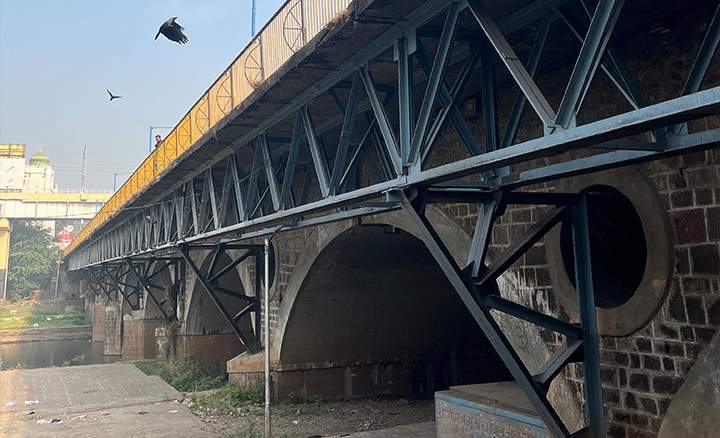
The Sangam Bridge is exactly where its name suggests – at the confluence of the Mula and Mutha. Built in 1830, it was originally called Wellesley Bridge, in honour of General Arthur Wellesley, and later popularly known as “Vasli” by locals. The British built it to connect a rapidly growing cantonment town with the old city.
Originally built with timber, it was rebuilt in 1839 with rusticated masonry carved from grey trap stone. Its eight arches, wide road, and height of 47 feet above the riverbed made it one of the most advanced bridges of its time.
The floods of 1961 tried to shake its foundations, but like so many things in Pune, it stood firm after repairs. A railway bridge now runs parallel to it, adding to the layered urban fabric of the area. Somewhere beneath it all, a temple once stood on the ghat, a reminder that even the quietest places have sacred beginnings.

Mula-Mutha River: Bund Garden Bridge / Fitzgerald Bridge
If there’s a bridge that blends charm, history, and elegance, it’s the Bund Garden Bridge, also known as the Fitzgerald Bridge. Built in 1869 and named after Sir William Robert Vesey-Fitzgerald, the then Governor of Bombay, this bridge was designed not just for utility but also for beauty. Captain Robert S. Sellon oversaw its design, and the Royal Engineers built it for Rs 2 lakh, a princely sum at the time.
With 13 elliptical arches, spandrel arches, and open stone parapets, the bridge offered both form and function. The bund nearby, constructed in 1850 with funds from philanthropist Sir Jamsetjee Jejeebhoy, had already made the spot a destination. The bridge only added to its charm. Regattas were held here, visitors gathered to watch from its vantage points, and boat clubs like the Poona Boat Club found a home in the vicinity.
At one point, the bridge was decorated with statues of Medici lions, echoing Renaissance Europe, right in the middle of Pune. Colonel Sellon also landscaped the barren land around the bridge into a public garden, which later became Bund Garden. As traffic increased and the bridge aged, the Dr. Babasaheb Ambedkar Bridge was built in 2011 to share the load. Still, Fitzgerald Bridge remains framed today by open stages, walkways, and even a bird sanctuary.
Pune’s bridges aren’t just built of stone, wood, or steel. They’re built of memory. Of footsteps, processions, parades, and protests. Of floods survived, and movements sparked. From haunted arches to festive ghats, from colonial elegance to Maratha grit, each bridge is a page in Pune’s storybook. You just have to stop, look down at the water, and listen.